Get in the Loop
Have you — or has someone you know — ever gone to a play, seminar, house of worship, or musical performance, optimized your hearing device settings, and still had trouble hearing?
Why does this happen?
Hearing in Public Spaces
When you listen to a live speech, classroom lesson, classical guitarist, or clergyperson, your hearing device uses a built-in microphone to capture the sound waves in the room. The sound is processed according to how your devices are programmed and then sent to your ear.
No matter how well your hearing device matches your hearing needs, however, other things in the room impact the sound waves before they reach your hearing device — for example, any background noise and the acoustics of the room.
What if there was a way to avoid all that impact?
There is.
The Hearing Loop
More and more organizations are installing something called a hearing loop into their performance halls, seminar rooms, and worship spaces. In addition to the usual sound system, these venues use a hearing loop to generate sound information using a magnetic field.
Let’s see how it works:
- A sound source, such as the headset used by a performer or seminar speaker, sends sounds to an amplifier.
- The amplifier sends a current through wires that surround the room along the floor, ceiling, or both.
- The wires generate a magnetic field (rather than sound waves).
- Your hearing aid picks up the magnetic signal using a tiny wire called a telecoil — most hearing aids and cochlear implants today have one already, and if not, it can likely be programmed into your devices.
- Your device processes the signal from the telecoil and converts it to sound.
- The sound is sent to your ear canal.
Benefits of a Hearing Loop
Knowing how a loop works doesn’t reveal much about why you would want to use one, though. Here are just some of the benefits:
Sound quality. By far the greatest benefit is sound quality. The magnetic signal received by the telecoil isn’t affected by things such as background noise and the acoustics of the room, so speech and music sound clearer.
Ease of use. To enjoy improved sound quality, simply switch your hearing device’s setting so it’s using the telecoil rather than the microphone to receive sound. You don’t have to build extra time into your schedule to pick up and return special equipment.
Versatility. Enjoy seamless hearing capabilities across an array of environments, such as theaters, places of worship, classrooms, and even businesses like pharmacies.
Discretion. Taking advantage of loop technology is inconspicuous, which encourages participation and inclusion, increasing the likelihood of adoption on a more widespread scale.
Using a Hearing Loop
Now you know about hearing loops, and perhaps you’re even a little excited by the idea — so what’s next?
Visit your hearing care provider. Though turning on the telecoil setting of your device is simple, you need to be prepared before exploring looped venues. Your provider will need to ensure the telecoil programming matches your regular programming as closely as possible. They’ll also need to show you how to switch to and from the telecoil setting. Different manufacturers — and even different models from the same manufacturer — handle the telecoil differently.
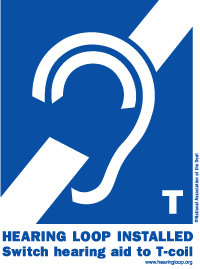
Identifying looped venues. Venues equipped with loop technology prominently display an internationally recognized symbol — a deep blue background emblazoned with a white ear, a diagonal white bar, and a capital letter T in the lower right corner. Hearing loops are the internationally accepted standard for hearing accommodation. The symbol assures people with hearing loss that their needs will be met.
Ensure everything works. Sometimes venues are set up for looping, but the equipment isn’t turned on. If you saw the telecoil symbol somewhere in the building, you’ve turned your device to the telecoil setting, and nothing seems to be working, seek out management to see if the equipment needs to be turned on.
Spread the Word About Hearing Loops
Once you’ve successfully used a hearing loop, consider mentioning them to the management of the places you frequent. Many businesses have never heard of a hearing loop but would gladly consider installing one to ensure their business is more accessible and comfortable for those with hearing loss.
The more hearing loops become commonplace, the more likely you are to see them pop up in places like grocery stores, shopping malls, and even homes.


 Proudly Canadian and Independently Owned and Operated


In the Time of COVID-19: Hearing Loss and Masks
in Hearing, Tips & TricksThese days, masks are essential for our safety when it comes to social distancing and preventing and/or reducing our exposure to COVID. However, for those who are deaf or hard of hearing, masks can make communication more difficult.
People with hearing loss tend to utilize Speech-reading or lip-reading, where a person focuses on another’s face – especially their lips – to gather visual cues from their facial expressions and mouth movements to help reduce the lack of speech clarity that can occur as a result of hearing loss. When a person wears a mask, it covers the lower half of their face so you can no longer see their mouth, and it’s harder to see full facial expressions.
Here are some beneficial strategies that we can all use to help improve communication:
Additionally, masks can sometimes be tricky for hearing aid wearers with a behind-the-ear (BTE) style aid, as the wires or tubes can get caught in the mask loops and become tangled up, increasing the risk of them falling off and getting lost when the mask is removed.
Tips for keeping your hearing aids safe and secure:
We hope these recommendations help!
Until next time,
Your friendly neighbourhood audiologists.
In the Time of COVID-19: Hearing Loss and Restaurants
in Hearing, Hearing loss, Tips & TricksIf you are hard of hearing, you have most likely experienced some degree of difficulty when going out to eat at a restaurant. Ambient conversations from other diners, noisy kitchens and background music can create a challenging auditory environment where it is hard to hear and understand your communication partner(s).
Additionally, during the COVID-19 pandemic restaurants have been utilizing their patios for service in order to ensure the safety of their patrons and follow social distancing guidelines. And as the majority of the province prepares to enter Stage 3 of reopening, more and more patios are open for business. The introduction of further background noise from outdoor sources makes it even more difficult for people with hearing loss. So here are some tips and tricks to ease communication in these dining situations!
If you wear hearing aids, their directional microphones are designed to focus on sounds in front of you while reducing sounds behind you. Sit with your back to the majority of the noise so the hearing aid microphones can perform the most effective noise reduction. It is also better if your communication partner has their back to a wall, so they are one of the only sources of sound positioned in front of you.
More people (and if you’re on a patio, more traffic) means more background noise. If possible, choose a less busy time of day to go out for your meal.
If you are dining inside the restaurant, request a booth. They typically have higher backs that can block some of the background sound in the room. Also, the seats usually have padding that can help dampen noise.
For example, if the music is too loud, you can tell a staff member that you are hard of hearing and ask if they wouldn’t mind turning the music down while you dine.
With some online research, you can discover which restaurants have a better atmosphere for easy conversation. And if you have a smartphone, you can download the SoundPrint app, which is available on iPhone and Android: SoundPrint utilizes a decibel meter to measure the level of sound at the venue, and then submits it into the database for all users to see. (Note: Android does not have the decibel meter function, however you can subjectively rate the volume of the restaurant for the database). SoundPrint has almost 100,000 different entries across Canada and the United States, so there are plenty of places to research and find a quiet spot for your next meal.
These beneficial strategies should help ease your communication while dining out! Enjoy!
Hear Your Best On The Go
in Hearing Accessories, Hearing Aids, Maintenance6 Tips to Keep Your Hearing Aids at Their Best
Whether you’re on the town or out of town, you depend on your hearing technology to keep you consistently connected. Don’t miss a moment when you’re on the go with these tips for maximizing your hearing.
Protect Your Tech
Hearing aids are tiny computers — keep them safe! If you’re in warmer climes, invest in hearing aid accessories such as a splashguard, a wind protector, or a sport clip. For those of you in less toasty towns, a hat, a scarf, or earmuffs can provide protection.
Use Geotags
Many hearing aids now come with a smartphone app that can assign a geographical “bookmark” — or geotag — to your favorite locations. Simply optimize your hearing aid settings for a location (for example, a coffee shop) and apply a geotag. Every time you return to that spot, the app automatically switches to your preferred settings.
Power Up
Always have extra packages of batteries on hand — don’t wait for the low-battery warning beeps from your devices. If you have rechargeables and you know you’ll be gone overnight, don’t forget the charger!
Keep a Kit on Hand
Whether hitting the road or just heading to the park, you never know when moisture or debris might strike. A pocket-size case filled with essential hearing aid cleaning and maintenance basics is a must. A cleaning cloth, a soft-bristle brush (like the one included with your devices), wax guards, and domes (if applicable) take up almost no space but will be lifesavers in a pinch.
Loop It
More and more public spaces are installing hearing loops. Enable the T-coil setting on your hearing aids and the loop allows you to wirelessly receive audio directly in the devices. Look for the loop logo at participating venues.
Check AGXchange
Headed out of town? Check with us to find an AGXchange practice near your destination. With an AGXchange practice, you can depend on the same level of quality hearing care you’ve come to expect from us.
Contact us to find out more about DIY tips for caring for your hearing devices!
You Need Hearing Aids. Now What?
in Hearing Aids, Hearing lossQ: It turns out I need hearing aids. What’s my next step?
A: Hearing aids aren’t one-size-fits-all devices, so your question is a good sign you’re approaching this with the right mindset. Your first step is to confirm you’ve had a complete audiological evaluation.
An online “hearing test” can’t determine whether you need hearing aids — it simply reports whether you’re hearing certain sounds. Only an audiological evaluation can determine if you have hearing loss that requires hearing aids. If you haven’t had one, this is your next step. If you have, it’s time to schedule your hearing aid consultation.
Choose Your Provider
Any hearing aid is simply a tool. It has to be selected, customized, and fit to your ear by an experienced professional in order treat your specific hearing loss. Then it’s your key to a better quality of life.
A clinical audiologist or doctor of audiology has had postgraduate education and training in all aspects of the human auditory system. They’re experienced in diagnostics, hearing aid fitting and programming, providing strategies for adapting to your new technology, and supporting you in your adjustment period. In short, with an audiologist, you get a partner and guide, not a transaction.
Use the Buddy System
It’s ideal to bring a friend or family member to the appointment to have a second perspective on your hearing loss journey.
Review Your Results
You and the audiologist will review the results of your evaluation as well as all the things you’d like to improve through better hearing, such as hobbies, conversations with loved ones, and activities. Knowing what your goals are will help determine the ideal type of hearing aid for you.
Select a Hearing Aid
Weigh the variables
Many factors determine what hearing aid you need, such as which sounds you can’t hear, how loud those sounds need to be amplified, and the size of your ear canal. And that’s just the beginning.
Do you want to be able to control the volume and nudge the settings with a smartphone app? How about “hearable” tech that monitors your heart rate and other body and brain wellness factors? Do you hope to stream music, video, and other audio from a mobile device direct to your hearing aids? You and your provider will discuss these factors and more. You’ll be surprised at everything hearing technology can do now!
Consider the recommendation
This is where the audiologist’s expertise really shines. When they make their recommendation, they will have synthesized all the hearing lifestyle information you provided, all the data from your hearing evaluation, and their wealth of knowledge about the hundreds of available hearing aid styles. They will have truly custom-tailored your solution.
Order the hearing aids
After you test-drive and decide on your hearing technology, there’s a strong chance it will have to be ordered and shipped to the provider. There are hundreds of styles — too many for your average provider to keep in inventory. Plus, many styles need to be custom fit to your ear canal. When they arrive at your provider’s office, your provider will call to schedule a fitting appointment.
As you can see, it’s not as simple as pulling a box of hearing aids off a shelf. But all these steps lead to you experiencing a world alive with sound!
Are You Protecting Your Hearing?
in Custom Earplugs, Hearing Protection, Hunting & Shooting Earplugs, In-ear Musician MonitorsFireworks and concerts might come to mind when pondering ear-busting sounds, but power tools and even some livestock can reach dangerous decibels, too. Let’s talk hearing protection, which can go a long way toward keeping harmful noise at bay.
Types of Hearing Protection
At home, work, or play, the world can be an exciting but noisy place, putting your hearing health at risk. How? Loud sounds — especially those in the danger zone of 85 decibels or higher — can lead to hearing loss, tinnitus, or both.
It’s helpful to avoid loud environments in the first place. That’s not always practical, however, especially if the job you love, favorite hobbies, and other important activities bring joy — and add some noise — to your everyday life.
Let’s talk about different types of hearing protection that can help keep you and your loved ones listening — and living — your best. Added bonus: Many of these options can be customized for a secure fit and maximum comfort.
CONCERT PLUGS
Rock out to your favorite artists without the dangerous decibels that can do a number on your hearing. These plugs are also ideal for machinists, airport and airline staff, dentists, music instructors, and others working in high-noise environments.
MUSICIAN PLUGS
Give it your all on stage without hurting your ears. Musician plugs can offer a high-quality audio experience that helps deaden external noise, provides clear sound, and helps achieve consistent performances.
HUNTING PLUGS
When it comes to hunting, you want the shot — not the hearing loss. Hunting plugs help keep out intense, harmful sound while allowing you to easily hear conversations, warnings, and other critical conversation.
SLEEPING PLUGS
Nothing beats a good sleep. Uninterrupted rest is even easier with plugs that help block out unwanted sounds and stay in place as you sleep. Especially recommended for light sleepers and those who work alternative shifts.
SWIMMING PLUGS
Not quite noise-related but still an important issue. Excess moisture in the ear from sweat or swimming can lead to otitis externa or “swimmer’s ear,” an outer-ear infection typically caused by bacterial or fungal growth when the skin in the ear canal potentially becomes irritated from water activities. Appropriate-fitting swimming plugs can help reduce this risk.
PET PLUGS
It’s true: Fur babies need help, too. During fireworks, noisy home repairs, or other super-loud situations, a quieter space may not be an option for the doggo or kitty. Earplugs and earmuffs made especially for pets can help soften intrusive sounds. Whether your pet will wear them, however, might be another matter!
Hearing protection is important and available for just about every member of the family. For solutions tailored to your or your loved one’s specific hearing-protection needs, contact our knowledgeable team today.
Hearing Aids + Your Brain
in Hearing Aids, Hearing Health, Hearing lossYou won’t “mind” this news about better hearing and improved cognition!
Does hearing aid use help your brain? A growing amount of research associates hearing technology with improved cognition and slowed or decreased risk of cognitive decline. Get the latest on research that supports your better-hearing health — and your mind.
Have you heard? Yet another study links hearing aid use to reduced risk of cognitive decline!
We’ve long talked about connections between hearing and the brain. They work together to help keep you empowered and engaged, so it’s no wonder that hearing difficulties could go hand in hand with cognitive problems.
The good news? An increasing volume of research links hearing loss treatment to improved brain function or reduced risk of cognitive impairment.
A University of Melbourne study published in early 2020, for example, suggests that “more frequent use of hearing aids was associated with greater improvements in cognitive function,” per a university news release.
Investigators, whose study assessed nearly 100 hearing-impaired adults aged 62 to 82 before and after an 18-month period of hearing aid use, also discovered substantial improvement in “speech perception, self-reported listening disability and quality of life.”
“Most notably,” according to the release, “97.3 percent of participants in this study showed either clinically significant improvement or stability in executive function — their mental ability to plan, organise information and initiate tasks.”
The conclusions dovetail with other various studies over the years whose data suggest, respectively, that with hearing aid use:
As you can see, hearing health is connected to more than just the power of communication, and hearing aids can play a big role in your overall wellness. If you have questions about hearing and brain health or if it’s been a while since your last hearing exam, don’t wait. Contact our experienced team today. Together, let’s keep you hearing — and living — your best.
8 Hearing Aid Tips for Hospital Stays
in Hearing AidsChecking into a hospital can seem a little stressful, making it all the more important to feel empowered, alert, and engaged with the help of your hearing aids. Help protect them during your inpatient visit with these handy tips.
It can be easy to lose track of your hearing aids when getting inpatient care at a busy medical facility, so we’re sharing eight tips to help you protect your tech and continue hearing your best.
Keep a personally labeled container on the nightstand for your hearing aids when not in use. And remember: Hearing-aid dryers and dehumidifiers can double as storage, too!
It might seem convenient to set your hearing devices on your food tray, but they can get damaged or lost that way. Better to keep them in their designated container.
If staff comes to change the bedsheets and you’re unable to get out of bed, remove your hearing devices so they don’t fall off in the linens and get discarded.
Pockets seem naturally convenient for storing hearing aids, but not so fast! Your devices could become forgotten there and end up being tossed into the washing machine and damaged.
Remember at night to remove the batteries from your hearing devices and leave the battery door open, helping reduce moisture and maximize battery life.
Consider not keeping your hearing aids with you and instead having friends or family bring them when coming to visit, if that’s feasible.
Make sure your medical team is aware if you have a significant hearing loss, and tell your doctor if you’re concerned about being able to hear just before surgery or in recovery.
Inpatient facilities typically don’t assume responsibility for lost hearing aids, glasses, or dentures, so provide a checklist to loved ones who can help you keep these critical items safe and sound.
Communicating on your terms means keeping your hearing technology safe, sound, and ready when you need it. For more tips on protecting or maintaining your devices, please don’t wait. Contact our caring team today. We’re here to help!
Hear Better at Home
in Hearing Accessories, Hearing Aids, Hearing lossYou might be surprised how many small ways you can complement the better hearing you already get from your hearing aids. Read on to learn about technology that can improve communication — and connection — even more.
If you’re adjusting to hearing technology, you’ve no doubt noticed how many situations around the home could be improved through better hearing, especially if you’re retired, work from home, or have relatives who live far away.
Today’s hearing aids are tiny computers, which means they can take advantage of the latest in computer technology — and you can take charge of your hearing.
Captions
For those with hearing loss — with or without hearing devices — closed captions improve speech understanding. But if you’re on a video call with loved ones in a different state, or you work from home, is that even possible? Turns out, it is.
Video calling platforms
For personal use, such as video calls with loved ones, Skype and Google Hangouts offer closed captions. For businesses, Microsoft Teams now offers captions only in meetings, and Zoom doesn’t have a built-in capability, but captions can be generated by a third-party service.
Apps
You can also download mobile apps to create closed-captioning for phone and video calls. Google Live Transcribe (Android), Rogervoice (iOS and Android), and Otter (iOS and Android) transcribe your calls in real time. Google Duo, which works on both iOS and Android, is a video-calling app that will soon offer captioning.
Streaming
Streamers
Did you know there are devices that allow your TV, stereo, or other sound source to “talk” to your hearing aids wirelessly? In other words, with these devices, your hearing aids become wireless headphones. The process is called streaming, and the devices are called streamers.
There are streamers to handle any kind of input. Some use a microphone to capture soundwaves in the air, others are plugged directly into the sound source, still others can receive a traditional Bluetooth wireless signal. But all of them use an FM signal or electromagnetic field to “talk” to your hearing aids.
What does this look like in action?
There are also mini-remote controls available that allow you to discreetly adjust your hearing aid settings or volume from your pocket or purse!
Made-for-smartphone
Hearing aid batteries are not strong or long-lasting enough to support traditional Bluetooth technology. That’s why most streamers use an FM signal or electromagnetic field to talk to your hearing devices.
But some newer hearing aid models are equipped with a newer, low-energy version of Bluetooth. These hearing aids can stream the sound directly from your smartphone, tablet, or other mobile devices — no streamer needed! You can even use your smartphone to discreetly adjust your volume or settings.
This same streaming technology lets you use your phone as a microphone. Simply place your phone where you want to pick up conversations, music, or other audio and activate Live Listen (built into iOS) or Headset Remote (an Android app). Whatever sounds your phone picks up will be streamed to your hearing devices.
There’s a vast array of options for making your hearing even better around the house — contact us today to learn more!
Q&A: What To Expect At A Hearing Evaluation
in Hearing HealthWhat To Expect At A Hearing Evaluation
Q: What can I expect at my complete hearing evaluation?
A: Many people think a hearing evaluation is where your provider plays a tone, and you simply indicate whether you can hear it. Fortunately, a hearing evaluation is more thorough than that and happens in four steps.
A typical hearing evaluation lasts from 30 to 90 minutes, and we encourage you to bring a trusted loved one with you. We find that a complementary perspective can help paint a complete picture of how your hearing loss is affecting you and your family. They can also take notes for you to refer back to later.
The Conversation
During this step, we review and discuss your medical history. You describe what sort of hearing problems you experience in common situations and how the hearing issues affect you and your loved ones.
But we’ll go beyond that, because the better I know you, the better I can custom-tailor a solution to your unique hearing loss.
We discuss your workplace, your hobbies and activities, and your family life. We do this so I can understand what might be causing your hearing loss as well as what things are key to your hearing lifestyle now and moving forward.
The Examination
Did you know sometimes resolving hearing loss is as simple as a good ear cleaning? That’s why the first thing that happens after our conversation is an ear inspection with something called an otoscope. This allows me to see if earwax, fluid, or debris is blocking your ear canal and whether a part of your ear is damaged.
The Diagnostic Evaluation
This comprehensive evaluation comprises tests to determine the degree and type of your hearing loss as well as the conditions of your outer and middle ear. Which tests are performed depends on your age, symptoms, and medical history. Everyone, however, receives the first three tests.
This test is what people think of as a hearing screening or test. You put on headphones, listen for beeps or tones, and indicate which sounds you can hear. With this test, I can determine the quietest sound you can hear at different pitches.
A different kind of headphone is used for this test. It tells me from where your hearing loss most likely originates and, therefore, what kind it is.
You will hear words via headphones and you’ll repeat them. This measures how well you hear and understand words at different volumes.
Placing a probe at the end of your ear canal, I will painlessly use air-pressure changes to see if your eardrum moves correctly, doesn’t move enough, or has a hole in it.
Using a different kind of probe, I will send a sound into your ear canal. Based on how your inner ear responds, I can learn information about the very tiny sound-receptor cells in your inner ear.
The Solution
Treatment options are based on all of the preceding steps. Because no two hearing losses are the same, no two solutions are, either.
Reviewing the results
We’ll review the results of your examination and diagnostic tests to determine whether you have hearing loss, what type, and what your options are moving forward. For example, you might require further evaluation from an ear specialist if the physical examination reveals damage to your ear.
Technology options
If we decide technology is your best option, we’ll determine together what style and level of technology will best support your hearing goals.
For example, some people require technology that filters out lots of background noise, whereas others don’t. Some people have ear canals that will accommodate completely-in-the-canal technology; others don’t.
An Active Participant
This process is all about your unique hearing needs. Don’t be afraid to ask questions, request that I repeat something, or be candid. This evaluation is the beginning of a relationship, not a transaction. Your active participation will lead to the most satisfying outcome for your hearing health.
Contact us if you’d like to know more about the process or to schedule an evaluation!
Get in the Loop | Hearing Loops & How To Utilize Them
in Hearing Loop, Hearing lossGet in the Loop
Have you — or has someone you know — ever gone to a play, seminar, house of worship, or musical performance, optimized your hearing device settings, and still had trouble hearing?
Why does this happen?
Hearing in Public Spaces
When you listen to a live speech, classroom lesson, classical guitarist, or clergyperson, your hearing device uses a built-in microphone to capture the sound waves in the room. The sound is processed according to how your devices are programmed and then sent to your ear.
No matter how well your hearing device matches your hearing needs, however, other things in the room impact the sound waves before they reach your hearing device — for example, any background noise and the acoustics of the room.
What if there was a way to avoid all that impact?
There is.
The Hearing Loop
More and more organizations are installing something called a hearing loop into their performance halls, seminar rooms, and worship spaces. In addition to the usual sound system, these venues use a hearing loop to generate sound information using a magnetic field.
Let’s see how it works:
Benefits of a Hearing Loop
Knowing how a loop works doesn’t reveal much about why you would want to use one, though. Here are just some of the benefits:
Sound quality. By far the greatest benefit is sound quality. The magnetic signal received by the telecoil isn’t affected by things such as background noise and the acoustics of the room, so speech and music sound clearer.
Ease of use. To enjoy improved sound quality, simply switch your hearing device’s setting so it’s using the telecoil rather than the microphone to receive sound. You don’t have to build extra time into your schedule to pick up and return special equipment.
Versatility. Enjoy seamless hearing capabilities across an array of environments, such as theaters, places of worship, classrooms, and even businesses like pharmacies.
Discretion. Taking advantage of loop technology is inconspicuous, which encourages participation and inclusion, increasing the likelihood of adoption on a more widespread scale.
Using a Hearing Loop
Now you know about hearing loops, and perhaps you’re even a little excited by the idea — so what’s next?
Visit your hearing care provider. Though turning on the telecoil setting of your device is simple, you need to be prepared before exploring looped venues. Your provider will need to ensure the telecoil programming matches your regular programming as closely as possible. They’ll also need to show you how to switch to and from the telecoil setting. Different manufacturers — and even different models from the same manufacturer — handle the telecoil differently.
Identifying looped venues. Venues equipped with loop technology prominently display an internationally recognized symbol — a deep blue background emblazoned with a white ear, a diagonal white bar, and a capital letter T in the lower right corner. Hearing loops are the internationally accepted standard for hearing accommodation. The symbol assures people with hearing loss that their needs will be met.

Ensure everything works. Sometimes venues are set up for looping, but the equipment isn’t turned on. If you saw the telecoil symbol somewhere in the building, you’ve turned your device to the telecoil setting, and nothing seems to be working, seek out management to see if the equipment needs to be turned on.
Spread the Word About Hearing Loops
Once you’ve successfully used a hearing loop, consider mentioning them to the management of the places you frequent. Many businesses have never heard of a hearing loop but would gladly consider installing one to ensure their business is more accessible and comfortable for those with hearing loss.
The more hearing loops become commonplace, the more likely you are to see them pop up in places like grocery stores, shopping malls, and even homes.